


Resurrections by Ada Hoffmann releases December 19. Preorders are on sale now.
This collection of short stories and poems by Ada Hoffmann traverses extraordinary universes packed with faeries, cyborgs, talking otters, punitive gods, lovestruck sea creatures, fossil hunters, extraterrestrials, and much more. Exploring themes of love and self-existence, community and otherness, and perseverance, Resurrections is a wondrous blend of genres and literary forms.
The author joined us for a photo tour of Barcelona, where they recently visited.
~~~
On November 7th I found myself creeping into a tiny seat at the back of an airplane, ready to make my first venture outside Canada since before the pandemic: a hop to Philadelphia, and then a big overnight flight over the Atlantic ocean to Barcelona, Spain. Why was I going so far all of a sudden? Because my Outside trilogy – a cosmic horror space opera centering queer and neurodivergent characters – had been translated into Catalan, a minority language from the area around Barcelona. Just in time for the Catalan launch of the third book, I’d been invited to visit and speak at Barcelona’s Festival 42, as well as at local bookshops which were launching the finale to the series.

The plane to Philadelphia.
[Alt text: A shot out the window of an airplane, showing the airplane wing flying over a suburban, autumnal landscape. The sky overhead is streaked with the pink of early sunset.]
This had all been in the works for about a year, and I’d been preparing and worrying (and, secretly, wondering if this was maybe a scam.) In the English-speaking world, my books are well-liked by a relatively small group of readers. I get to show up at conventions every so often, but I don’t get people offering to fly me halfway across the world at their expense. The Barcelona offer felt surreal, but I wasn’t about to turn it down. I was very excited. I wasn’t completely sure what to expect.
Little did I know that I was going to be welcomed in this city beyond my wildest dreams. I want to tell you all about what I experienced in Barcelona, and how it revitalized my belief in what writing can mean. (I also want to show you an excessive amount of my vacation pictures. I’m only human.)

The Barcelona city centre.
[Alt text: A city square with several pedestrians milling around. A sculpture in the square forms the letters “I Heart BCN,” which are also printed on a large sign. Behind the sculpture is a city street with elegant apartment buildings, trees, and church spires. The sky above them is blue, with cirrus clouds.]
Editorial Chronos, the publisher that produced the Catalan translation of the Outside books, is just two guys – Gonzalo and Toni. They both have day jobs, attend language and literature classes, and publish a few translated sci-fi books a year as a hobby. Nevertheless, their books are beautifully printed and prominently featured in Catalan language bookshops alongside other science fiction; a situation which you would never see with a press this small in the English language market.

Me with Gonzalo and Toni.
[Alt text: Three people wearing fall jackets and sitting in a streetside cafe. All three are smiling at the camera.]
They had arranged a delightfully busy week for me including festival events, visits to bookstores, and an interview and photo session with a Catalan newspaper. The events had professional interpreters and everything, and they were each well-attended, ending with a startling long line of people wanting their books signed:

Book signing line-up at Festival 42.
[Alt text: A white person with long brown hair sits behind a wooden desk in a converted industrial space, wearing glasses, a beige face mask, and a red blouse. A sign on the desk says “Signatura de Llibres.” A small crowd of people have gathered in front of the desk with books to be signed.]
It’s that difference between English fandom and Catalan fandom that really struck me. In Catalan, there is a long tradition of fantasy literature, but classic sci-fi was not translated into Catalan until the past 4-5 years. This didn’t stop Catalonians, who are usually bilingual in Catalan and Spanish, from reading sci-fi in Spanish – as evidenced by the small and thriving neighborhood of comic, game, and sci-fi bookshops near the hotel. Residents call this block “the Freaky Triangle” – “freak” being used as a loan word, in Catalan, to mean “geek” or “nerd.”
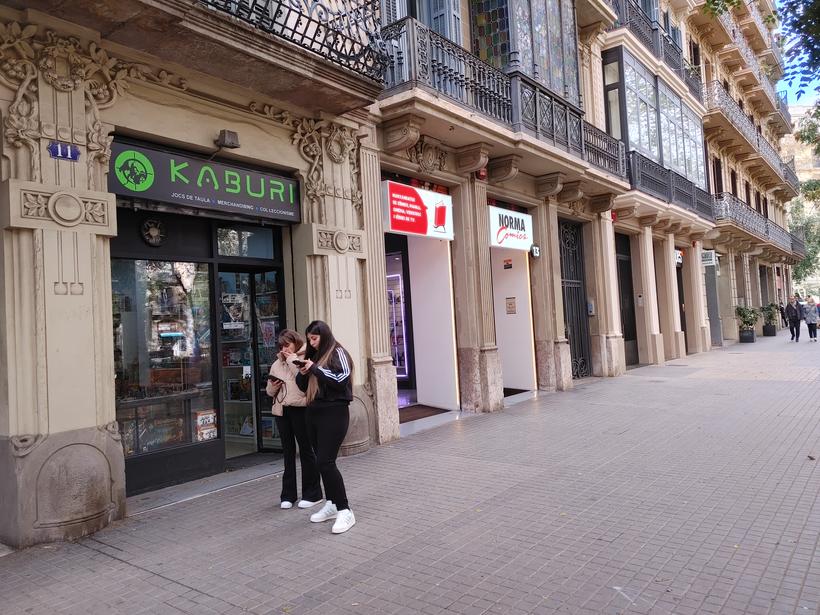
Shop fronts in the Freaky Triangle.
[Alt text: A paved pedestrian walkway next to an elegant facade of buildings with apartment balconies on the upper floors and shop entrances on the street level. The buildings have elaborate carvings, pillers, and wrought iron balconies. One shop front has a sign that says “Kaburi” in green letters on a black background; another says “Norma Comics” in black and red letters on white; the other signs are far off and illegible. A pair of women check their cell phones in front of the “Kaburi” store.]
But for readers who prefer to read in Catalan, sci-fi books in their language are a new thing, and they’re getting it all at once, from classic speculative literature of the early 20th century to modern authors like Adrian Tchaikovsky. Catalonian women in science fiction feel overwhelmed by a barrage of male authors to an even greater extent than women in the English language market. So for a lot of Catalan readers, the idea that a queer autistic woman could be the protagonist of a space opera was completely new, and mind-blowing!

One small section of the booksellers’ table at Festival 42.
[Alt text: A pile of books for sale on a table. The pile is neatly organized and includes works by Michael Ende (Momo); Ada Hoffmann (L’Extern, Els Caiguts, and L’Infinit); Hector German Oesterheld (El Eternauta); Shirley Jackson (La Loteria; La Maldicion de Hill House; Sempre Hem Viscut al Castell); Layla Martinez (Carcoma); and others whose titles and authors are not fully visible.]
In English we’ve known for a long time that representation in fiction is important. At times it feels like we’ve gotten so used to the idea of representation that we almost take it for granted, or get burned out on the idea. We get bogged down in arguments about exactly how to do representation (does it need to be #ownvoices? Does it need to be “positive”? Does it need to be this, or that?) and we can forget the joy of seeing a character you relate to in a story for the first time. Catalan readers haven’t forgotten this yet.

Giving a talk at La Carbonera bookstore.
[Alt text: Screenshot of an Instagram post in Catalan by editorial_chronos. The picture shows a crowd of people on folding chairs in a bookstore, surrounded by books. A series of multicolored party streamers hangs overhead.]
Some of the Catalan fans I spoke to had incredible stories. One, autistic herself, said that she’d first discovered my books because her therapist recommended them. Another said he is now seeking an autism diagnosis because he related to Yasira, my protagonist, so intensely. One fan, who was neurodivergent and had PTSD – the latter being a big theme throughout the trilogy – tweeted to say that, after I signed her copy of the Outside, she had to stand still and hold back tears. I was absolutely floored by all these responses in such rapid succession. It’s not that English-speaking readers have never responded so intensely to my books, it’s just that English-speaking fans tend to be a lot more geographically spread out and I never get hit with such a deluge of so many of them at once. It’s also, I suspect, a mild cultural difference – with people in warm, Mediterranean cultures tending to be a little more effusive and welcoming.
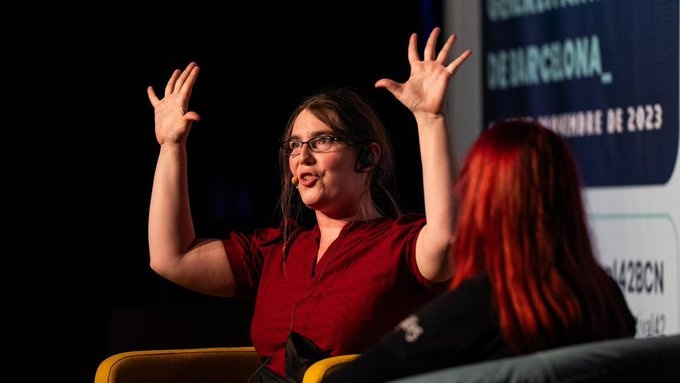
My interview at Festival 42. Picture courtesy of Zowy Voeten of La Vanguardia newspaper.
[Alt text: Two people sit in armchairs on a festival stage, with a black background. A white person with long brown hair, glasses, a microphone, and a red blouse raises their hands dramatically in the air while speaking. The other person has long, bright red hair and only the back of her head is visible as she faces the speaker.]
For instance, I also got handed little presents by the organizers at every event I went to.
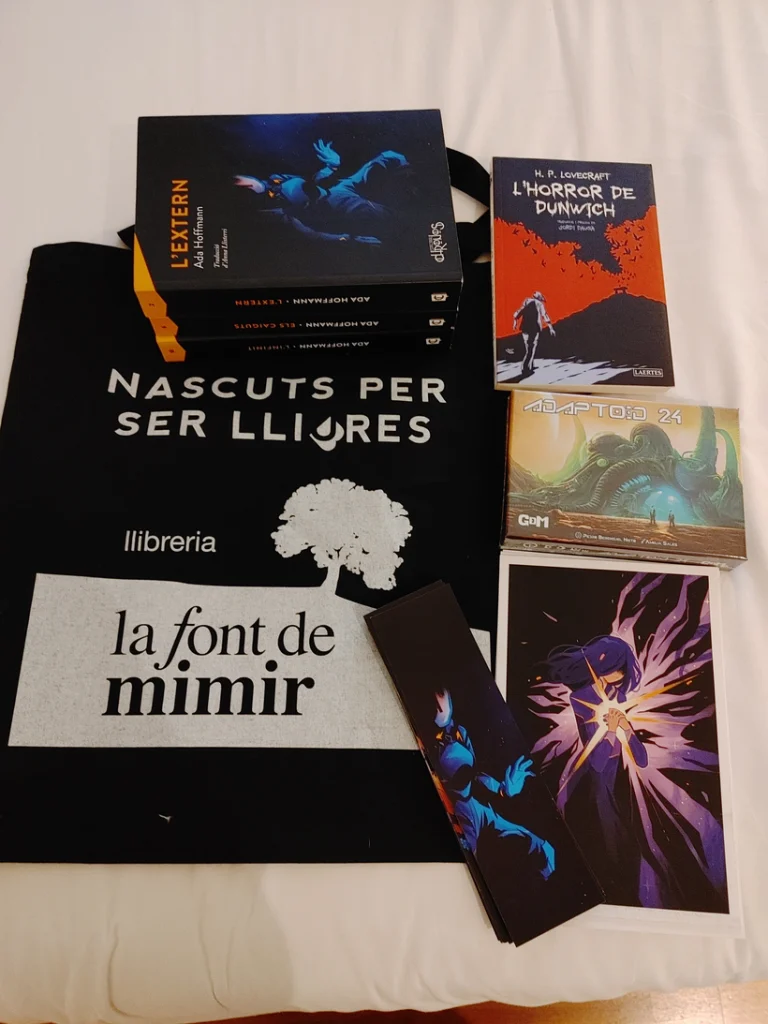
Presents from La Font de Mimir book/game shop.
[Alt text: A collection of gifts laid out on a white hotel bedspread. They include copies of the Outside trilogy in Catalan translation; bookmarks and art cards with the Catalan cover art; “L’Horror de Dunwich” by H.P. Lovecraft; a card game called Adaptoid 24; and a black tote bag that says “Nascuts per ser Llibres: llibreria La Font de Mimir.”]
But there’s more to the magic of Barcelona than just the enthusiasm of fans and a culture of generosity. I was astonished by the level of financial and material support that seemed to materialize here. Remember when I said Editorial Chronos is a tiny press run by two guys as a hobby? Yet, they were able to pay my hotel and airfare, as well as countless other little conveniences that I didn’t even think to ask for – taxi fare to and from the airport; a public transit pass; lunches out on the town; bookmarks and art cards of the Catalan cover art.

Pintxos, a traditional Basque food.
[Alt Text: A white plate containing five pintxos on a polished wood tabletop. Each pintxo is a small slice of crusty bread topped with an assortment of meat, seafood, cream cheese, olives, and similar toppings with a long toothpick stuck through it to keep it together.]
This is partly due to the support of the Barcelona city government, which is very invested in promoting the Catalan language, and which really wanted Festival 42 to succeed. Like many minority languages, speaking Catalan has a political dimension, which – as a North American – I only partly understand. The history of tensions between Catalonia (speaking Catalan) and Castilia (majority Spanish culture, speaking Spanish) is complicated, and there is a strong Catalan separatist movement today; actually, this region already voted to secede from Spain but then was told it wasn’t allowed.

This guy is a mascot encouraging people to speak more Catalan.
[Alt text: A mascot statue stands in a city square in front of a stately stone building. The mascot is a red cartoon jaw with gums and white teeth, with thin arms, legs, and googly eyes attached. A sign above the mascot, in the shape of a speech bubble, says “Provem-ho en Catala. Mort per parlar, molt per viure.”]
But it’s not only about the Catalan language. Festival 42 also hosted several sci-fi authors who have only been translated into Spanish – including Ann Leckie, Cat Rambo, Steven Erickson, and Tim Pratt – and they were just as welcoming to them as they were to me. All the international guests in the festival were given rooms in the same hotel, plus an envelope of “meal tickets” – provided in an envelope, with a letter of thanks from the city – which paid for alarmingly sumptuous three-course lunches and dinners in the hotel restaurant.
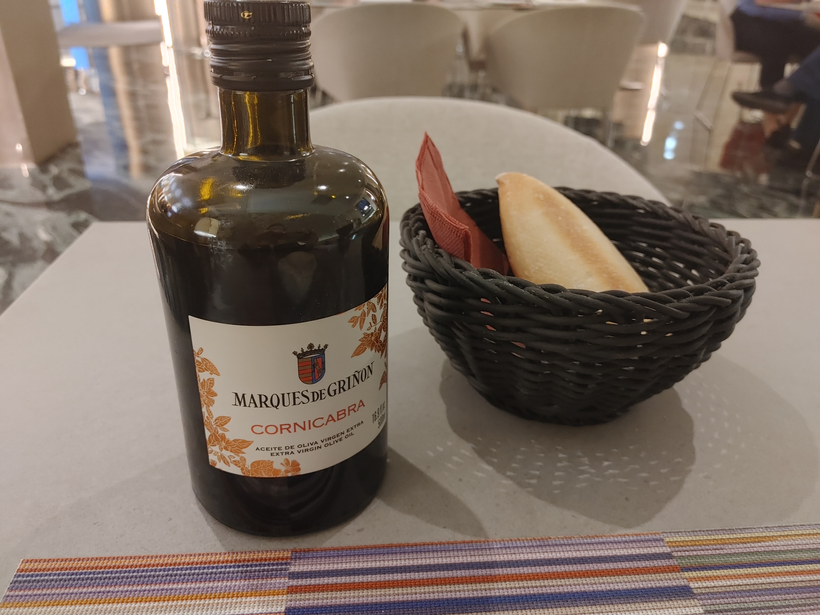
A bread basket that came with each meal. In Spain, instead of butter, people drizzle olive oil on their bread.
[Alt text: A bottle of olive oil and a basket containing a dinner roll, arranged on a small table in a hotel dining room.]
The arts in general are very important here in Barcelona, which boasts connections, in particular, to many of the most important artists of the modernist movement, including Picasso, Dali, and Miró. The city’s biggest claim to fame is the eccentric architect Antoni Gaudi, whose fluid, organic shapes are instantly recognizable.

The outside of La Pedrera.
[Alt text: A multistory building stands above a wide pedestrian walkway. Unlike the elegant but rectangular buildings around it, its facade sticks out in irregular, curved waves. Pedestrians, trees, and a blue sky with cirrus clouds complete the scene.]
Gaudi’s greatest work was the Sagrada Familia cathedral, which is still under construction today and which everyone agrees is the single attraction you absolutely can’t miss if you are visiting Barcelona. I missed my chance to visit the Sagrada because I underestimated just how fast the tickets would sell out, but I made time on my visit a few of his lesser-known works. Here’s La Pedrera, an apartment building converted to a tourist attraction:

[Alt text: A courtyard inside a multistory building. Stairs and windows ascend in curved patterns with bright pastel colors and flowers.]
And the Park Guell, a municipal garden:
![[Alt text: Curved stone benches wind between a series of irregularly shaped stone pillars, with a stand of trees behind them and a wide pedestrian walkway in front. A glimpse of blue sky is also visible.]](https://on.patronhunt.com/apex-publications/wp-content/uploads/sites/7/2024/01/guell1.webp)
![[Alt text: A group of tourists sits and talks on an elaborate balcony, surrounded by a low wall of multicolored tiles. The balcony is supported by pillars which go far down into a green area full of trees. Further in the distance, various different city buildings are visible, and in the far distance there is a faint glimpse of the sea.]](https://on.patronhunt.com/apex-publications/wp-content/uploads/sites/7/2024/01/guell2-768x1024.webp)
Anyway, it’s the Barcelona government’s deliberate policy of support for the arts which made it possible for a midlist author like me, with a smallish but devoted audience, to be brought in and feted like a guest of honor.
And I suspect it’s also the Spanish government’s other economic policies which make it possible for people like Gonzalo and Toni to comfortably do the publishing work that they do, instead of scrabbling just to survive in the capitalist maze.
Not to get on a politics soapbox but this kind of support for authors doesn’t only benefit me – but also all the publishers, booksellers, and crucially the fans, for whom these books are so important. We could support the arts this way in North America too! We have the technology! All that’s missing is the political will.
Meanwhile, I want to finish you off with a few more tourist pictures.
![[Alt text: A wide, paved alleyway between tall and old-fashioned stone buildings.]](https://on.patronhunt.com/apex-publications/wp-content/uploads/sites/7/2024/01/street-768x1024.webp)
A street view from the neighborhood of Barceloneta.
![[Alt text: A view of the Mediterranean Sea. Bright blue water predominates the picture under an equally bright blue sky. In the distance a shoreline can be seen with sandy beaches and various city buildings, as well as the shapes of mountains further away. In the foreground, a pile of stones juts into the water, a few of them decorated with colorful graffiti.]](https://on.patronhunt.com/apex-publications/wp-content/uploads/sites/7/2024/01/sea.webp)
The Mediterranean Sea.
![[Alt text: A large gray rock in a display case, containing an iridescent, rainbow-colored nautilus fossil.]](https://on.patronhunt.com/apex-publications/wp-content/uploads/sites/7/2024/01/ammonite.webp)
An ammonite from the CosmoCaixa science museum
I’ll never forget Barcelona – not only because they welcomed me so warmly, but because they reminded me why the kind of writing I do is important – and what it can look like when we make space for this work to thrive.
~~~
Thanks to the author for joining us! Resurrections releases December 19. You can preorder it now!
Leave a Reply